Showing posts with label Did You Know?. Show all posts

Friday, June 5, 2026

Colchester Cemeteries Quest - Exploring History, Part 2

 
Like the previous outing, I set out to visit two more local burial grounds. The largest of the Colchester Cemeteries, the Village Cemetery sits behind the Burnham Library. 

It's also worth noting there's strong historical interest within our community with an active Colchester Historical Society. We recently went to a talk about a regional railroad line.

Thus, I was intrigued to immediately spot the Burnham name. But the library wasn't named for Herbert, but rather Etta. Upon his retirement in Massachusetts, they moved back to where she grew up, both serving the Colchester community. After Herbert passed, Etta lived a few more years. She willed most of her estate to “build, furnish, and maintain a library.”


The Leggett headstone is a sad reminder that parents, especially during wartime, often outlive their children. Only 2 of 4 children lived to old age.

The Nourse name caught my eye because there's a region where Bay Road meets East Lakeshore Drive, with a pretty view of Malletts Bay - still marked as Nourse's Corner on Google Maps. It was a snack bar hot spot in the 50's, and I recall my parents mentioning the place. George Nourse started the snack bar, which specialized in toasted hot dogs, and it ran for 20 years, though it didn't survive his passing. 

Regionally, Michigan-style hot dogs, split lengthwise, grilled, then topped with meat sauce and mustard squiggles, served on a toasted bun, were popular when I was younger, and still found today at Beansie's Bus in Burlington's Battery Park. Once in a while, I stop for this irresistible treat. 

Moses headed the Colchester regiment in the War of 1812.
The Moses stone is unique because the raised lettering is still visible on the marble stone. It's customary to see debossed lettering, like the right-hand gravestone, that, in time, marble doesn't weather well, especially in a harsh New England climate. Sometime over the past 200 years, stones were replaced with harder granite. Because of the differences, it's easy to spot older graves in any cemetery.

The older stones have interesting inscriptions: for example, specifying days lived or age at death. So much character in the old headstones!

I found an excellent, comprehensive online Colchester history resource, something I'll surely reference time and again.

The second stop was at the Old Methodist Church Cemetery, tucked away behind a firehouse on Main Street, formerly the Old Methodist Church site. At first, the grounds seemed neglected, sandy and barren, scrubby grass trying to survive. While a nice iron gate bordered the cemetery, it lacked signage, so I hope the colorful official marker is in the works. 

Upon closer inspection, I noticed the old stones were cleaned, and fragments pieced back together. There is a statewide Old Cemetery Association that helps communities preserve historical markers, with the help of volunteers.
 
Celebrating the life of Charlotte Johnson at 101 years old - amazing longevity for that time period. She outlived her husband by 40 years!

While headstones remain, trees and, eventually, stumps morph into headstones. 

Two more cemeteries to go!

Saturday, March 8, 2025

The Mittens that Everyone Needs


My hands suffer when it gets cold. While I have bar mitts attached to my commuter Peugeot, that bike is also decked with studded tires until the weather gods decide it's really spring, so alternative mittens are required to keep my digits from freezing, especially if I ride another bike on dry roads. Or, walking, shoveling, etc. 

I'd read how leather mittens with wool liners are some of the warmest outdoor wear you'll find, so I took the opportunity to replace some failing synthetic lined mittens with LLBean's version.

Call them what you will: double layers, choppers, chopper mitts, work mittens, or leather mitts, ultimately, they're the warmest mittens I've ever used!

The leather shell blocks the wind, grips the handle bar, while the wool liner is warm and replaceable, should one eventually need to. Critical is the air pocket between liner and shell that traps warmth. And if both get wet, just air dry separately. 

There are many brands available in this type of arrangement. And not to worry, I can grasp the shifters and brake levers just fine.

I'm reminded of the Dr Seuss book, The Lorax and  Thneed - the thing that everyone needs!

Tuesday, April 18, 2023

The Versatility of Folding Bikes on Amtrak - Dahon Boardwalk in Albany, NY

The Mohawk Hudson Bike Hike Trail, north of Albany, hugs the Hudson River.
 It's also the eastern terminus of the Erie Canal Trail. 

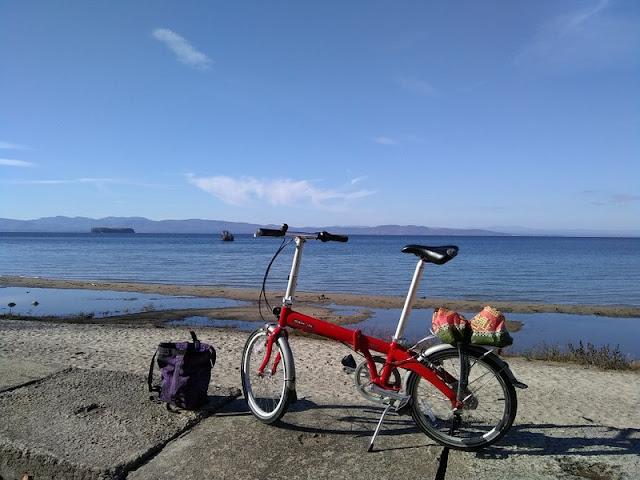
I'm a fan of the Empire State Trail system, so I waited for a good weather weekend to ride Amtrak to investigate the Albany, New York region with my Dahon Boardwalk. As I've learned, the Boardwalk rides best with limited baggage - perfect for indoor accommodation. With a new-to-me voluminous front bag, I was able to stow all my overnight gear, important for two reasons: easy carry-on while also lugging the folded bike on Amtrak (avoiding extra fee and a reservation), and because of pedaling both days, leaving late afternoon Sunday, returning by train, I had to tote all my gear on rides. It was a valuable exercise in packing essentials.


Pedaling five miles from home to the station, I easily folded the bike into a homemade tote, storing the bike behind my seat and settled in for a 5 hour journey.

In Albany, I lugged the folded bicycle to the train platform and assembled everything, then took the elevator one flight down to exit the station. Following verbal Google directions, I easily navigated over the Hudson River by way of a segregated bike lane.  

The goal for the late afternoon was investigating the nine mile Helderberg-Hudson Rail Trail, ending southwest in Voorheesville. It was a surprising elevation gain the entire way, but doable in lower gears. I enjoyed the bird life, roaring cascades, access to community parks, and near the end, a lovely display of public art. What a fast descent back to Albany!

View east towards the Hudson River from my hotel. A nearly full moon eventually
 rose between the buildings.
Settled into the Hilton after a 30 mile day, I enjoyed a burger and tasty Lake George IPA in the oddly empty hotel bar. The hotel was full with participants attending Pentecostal Church Easter events. The only hiccup was the next morning, waiting on the 14th floor for 30 minutes with a luggage cart before abandoning it it to squeeze into a nearly full elevator, my bike pressed up against someone's stroller.

I set off north of Albany on the Mohawk Hudson Bike Hike Trail. The park-like setting squeezed between a nearby noisy highway (87?) and the Hudson River, but was pleasant on a brisk morning, them ambled on road through Watervliet, and a portion of Green Island before entering trails again to Peebles Island.

The bridge and pedestrian walkway from Peebles Island to historically significant Waterford was over 100 years old. The pipe (at left) carries power to the island.

I really enjoyed Waterford, especially as it's the confluence of two defunct canal sections: a branch of the Erie and the Champlain Canal, and the intersection of the Mohawk and Hudson Rivers. Specifically though, I aimed for the gravel Champlain Canal Trail to continue north. 

The 4-5 mile trail followed the remnants of the old canal. A portion had turned into wetlands or was dry. A couple spots lined with canal stones looked like it hadn't changed much from its glory days, ferrying wood and goods southward to the Hudson River. 

Wild iris (?) and skunk cabbage.
Early spring growth oozed from the wetland.


A heron perched on a log caught my eye, plus an ugly snapping turtle...and numerous small black turtles sunning themselves on logs slipped into the pond as I pedaled by.

By far, the oddest experience on the canal trail was climbing over a landfill. I laughed out loud at the absurdity. But I also rather liked the idea of reclaiming land for other uses. With controlled monitoring, and signs indicating remaining on the gravel path, why not let users travel through?

I had been carrying the purple purse/bag slung over my body, but as the day warmed I found a better solution, looping the strap around the large bag. This allowed easy access to my phone for taking pictures.


On the return trip, I grabbed a sandwich and ate lunch at a lovely spot overlooking the Hudson River. Timing worked out perfectly to catch the train home, and riding in the dark, I arrived home around 10:30 pm.

Parting Thoughts
I find mini journeys satisfying and worthwhile. I was pleased that packing light actually worked very well. I somehow forgot my toothbrush, but could've also left one pair of tights at home, saving more space. My legs periodically brushed the bag cinched to the seat post, but wasn't that bothersome or I would've moved it. As backup, I carried a cargo net that could secure the bag or anything else on the rear rack. 

Weight in the front bag was about 10-15 lbs., half of that tools. In addition to the typical flat repair stuff, rubber gloves, and rag, I carried a new wrench that adjusts seat, removes axle nuts, and tightens pedals - an all-in-one tool that's a must for the folding bike.

As for the Amtrak legs, staff were extremely helpful, accommodating the heavy tote bag (my bicycle weighs 30 lbs.) I'm pleased to pedal from home, board a train, and travel several hours to ride in a new region. I'm encouraged to go on more Amtrak adventures!

Thursday, December 23, 2021

What is a Cycling Lifestyle?

Do you ride occasionally or is riding bikes an integral part of your life?

The cycling lifestyle as opposed to recreation cycling are two very different mindsets. As reported over the past two years, recreation cycling has hit an all time high during the pandemic, but I'm not sure it has increased cycling lifestyle participants. CLR Effect's recent blog post Hobby of a Lifetime touched on how others might perceive a mountain biker with scratched and bloody legs, which got me thinking about my cycling lifestyle traits and what sets many of us apart from a recreation cyclist.

Below are personal qualities that friends and family members fail to understand about me:

  • Preferring to ride instead of driving
  • Riding for errands because it's one more opportunity to ride and provides motivation
  • Choose vacation destination that are great for cycling
  • Often have more than one bike, primarily because if one requires maintenance than a bike is still available for riding
  • Are always thinking about improvements to their bikes
  • Frequently check weather forecasts
  • Riding more during the pandemic because it's therapy
  • When injured, one still tries to ride if at all possible
  • If you can't ride for more than two days, it's torture
  • Will ride in the darkness if that's the only available time to ride
  • Continually challenge myself with cycling: riding through the winter, have coffee outside, try different mountain bike trails

Do you recognize any of these cycling lifestyle characteristics? Do you have any more items to add to the list?

As a side note, I'm seeing our 19 year old son developing many of the above qualities since the start of the pandemic, so perhaps there will be one more person adopting the cycling lifestyle. I'm biased of course, but it seems like the perfect way to cope with loneliness brought on by the current health crisis.

Wednesday, April 7, 2021

The Great 2021 Terry Clothing Experiment!

a pile of Terry Bicycle cothing
What's a girl to do with all these choices?

For a long while I've preferred multifunctional garments over bicycle-specific clothing. But that wasn't always the case. I've tried to like padded shorts, however I wilt in heat and humidity, therefore wearing the least amount of clothing possible has been my preferred choice. I've had saddle discomfort for years, but I didn't know what to do about, short of taking periodic breaks from riding, and trying various saddles. 

I eventually settled on thin t-shirts, rayon button-down tops, or Hawaiian shirts - loose garments that allowed airflow, were quick drying, and virtually odorless when worn multiple times. For bottoms, I preferred stretchy cotton, yoga-style shorts. When the bottoms became threadbare and not easily replaced, I added cute Terry skirts for better coverage. It was a wonderful solution, whether shopping or riding to work - a presentable option for strolling inside until changing into business casual attire.

Enter the pandemic, and unemployment. 

I eventually found a new opportunity - of all places - at Terry Bicycles! Georgena Terry sold the saddle and clothing business 10+ years ago. Since then the office/warehouse has been in Burlington, Vermont. In a home office for the time being, I'm having fun trying various padded shorts, knickers, skorts, and breathable synthetic tops on evening rides. It's equally a personal experiment and professionally the best way to understand products. I suspect that riding in chamois-lined shorts during the summer heat will be the ultimate test. Couple that will testing saddles and I just may be the best dressed commuter rider out there!

I don't know where this journey will take me - I'm a creative soul - but I'm willing to go along for a short ride. 

In the meantime, let's all get on our bikes. :)

Monday, November 16, 2020

How to Revive Beloved Panniers


Before and after images: at left, original Overland system: top hooks with straps and tension buckles (and tiny rings that are supposed to hook under rack)  - difficult to use, though secure once placed. At right, the improved replacement Lone Peak system: locking top hooks with easier to remove common bungee and hooks.

Both Lone Peak front and cavernous Overland rear panniers have been rugged companions for both my husband and myself on a yearlong trip. Since then for local commuting and occasional short tours, we've worn out the smaller and easier to use Lone Peak pair, because their top hooks lock onto the rack - a brilliant design - but are easy to remove, using typical bungee and hook design secured to the rack bottom.  

Before tossing panniers (and helmets) I remove any hardware to repair future projects or to keep our existing equipment in decent shape. My husband needs rear panniers. Good panniers are expensive. I discovered that Lone Peak still sells their wonderful parts so in conjunction with a few pieces in my stash, I drilled additional holes in the rear bags, and with a lot of patience, I replaced the difficult Overland system with new Lone Peak hardware.

After a good wash, the Overland panniers look almost new!

High quality, made in USA, 1994 Overland panniers, We own a third back up pannier (the 4th was attached to a bike that was stolen) and another set of locking top hooks should we need to press an additional pannier into service.


Saturday, May 30, 2020

Ride to Visit Little Free Libraries

In early May, seeking another motivational ride challenge, I visited registered Little Free Library boxes in Burlington, VT. The map displayed 16 locations. I found 12; 3 were missing; and one I could not visit one because of it's location inside a closed university building. During these strange times, many sites are offering cleaning wipes (with little trash cans for waste), puzzles, food items, stands offering local newsprint editions of Seven Days, bee polinator plants adorned one lawn complete with educational material, and another place even cataloged clothing for those in need (see yellow boxes in next photo). Each box was uniquely designed, the only commonality was their official labeling as a Little Free Library. I restrained myself to carrying home two books.

What became clear, after stumbling onto other non-official sites since my quest, is that there's an equal variety of undocumented sites with their own flair that are bright spots in our community. 


Little Miss Sunshine library is also a community resource for clothing and food.

Wednesday, November 13, 2019

Coffeeneuring 2019 - Fourth Cup at Halfmoon Cove


New Places, New Spaces
Getting to know Colchester, Burlington's neighbor to the north, the next stop on my Coffeeneuring tour included the usual enjoyable ride on the waterfront path, a bit of single track to connect neighborhoods, then, leaving my bike behind, a short but steep descent to sip tea beside the swiftly flowing Winoooski River.

The Place:  Halfmoon Cove 
Date: Saturday, November 3
Drink: Uncommon Grounds ginger tea
Observation:  I didn't know there was river access, though I've passed this way several times.
Total Miles: 18


The river was still a bit high, but slowly receding from Halloween rains that dropped a whopping 3.7".


The real treat was discovering animal tracks on the river's edge. Later, I asked my husband and he said raccoons are known for washing their food before eating so they were probably raccoon prints. I was skeptical - he likes to make up explanations just to see if we believe him - but sure enough, he was right!

This is why I coffeeneur: to learn cool stuff like this.

Monday, March 6, 2017

Bike Blog Love - 5th Edition


Every year I seek out new bicycle blogs to follow. Here's my annual ode to a new (or at least new to me) batch of two-wheeled bloggers. Spread the link love!

Mr. Frivolous Cycling is a transportation cyclist in California and also enjoys unplanned outings. His goal this year is to complete a 45 mile charity ride. The heck with traditional training and hill sprints! Humorous and independent, I enjoyed his "tab" on bikes: he owns only one bicycle and it's my kind of color - purple!

Bikes For The Rest of Us

The blog has been around a while, but I've discovered it recently, stumbling on a Miyata Ridge Runner, which the blog describes as "RUB".....stands for Retro Urban Bike or Retro Utility Bike.
Bikes for the Rest of Us reviews practical bicycles - the blog title says it all.

Simply Cycle
I stumbled on this blog while researching Rivendell's Bosco bars. Marc hails from Michigan and is a part-time teacher. He taught some magic recently, opening teenage minds in The mouths of babes.

What This Bike Needs
Lizzie lives in England (I think) and has a penchant for sewing and cycling. She rides a step through bike - a woman after my own heart - and doesn't let hills stop her, last fall completing the Coffeeneuring Challenge.

It's All an Adventure
A long distance bus driver squeezing in rides wherever possible. I like his appreciation for wild life.

Riding the Mindway
Another Iowan, who rides as much as possible throughout the winter.

Citizen Rider
 A fellow New Englander, who loves the off season for skiing, works in a bike shop, and had the misfortune of thieves violating his home. While not a pleasant experience for anyone, I enjoyed his heartfelt portrayal of the awful day. May cafiend have a better 2017.

Max, the Cyclist
A gung ho young cyclist and bike packer who does his own hacks, uses practical gear and racks (basket packing), and has a spiffy blog. I discovered the Soma Lucas front rack through this blog, certainly a consideration for my Clementine.

Keep walking, even if it's steep
I've followed Jim's writing and adventures for many years. Jim owns three very practical bicycles and lives in Estes Park, CO. He's not a regular writer, but I enjoy reading his stuff when he does. Jim is not afraid to work on his own bicycles.

Thursday, August 6, 2015

Did You Know...The High Point of Kansas Has a Sunflower Made With a Bicycle Chain?

Who would have known there are such special places in the U.S. full of bike love - and a high point at that!


My husband and son are vacationing in several states; their primary goal is climbing summits and exploring along the way. My favorite by far is Kansas's amalgam of summit paraphernalia and my family's experiences with horned toads. If you want to see what's in the mailbox in the above photo, follow their vacation blog.

Wednesday, March 26, 2014

What is the Heroic Era?

A lady is about to cross the street  in the 1928 Tour de France when the peloton comes
streaming through. Photo credit: The Guardian Photograph: Collection Laget

The more I read about the Heroic Era the more I like what what the Tour de France used to stand for: strength and perseverance. Resourcefulness was everything. You powered your own single speed machine, fixed it as best as you could, fed and clothed yourself, and struggled onward pedaling over mountain passes caked in mud or snow. Grit, determination, and self sufficiency were characteristics that earned respect.

That was when the race consisted of epic journeys, like in 1920 when Honore Barthelemy lost his eyesight after a crash where his eye was struck by a flint. He still finished the race. And went onto compete in more Tour de France events with a glass eye he removed when dust became a problem. Eugene Christophe broke his fork in 1913. Since outside assistance was forbidden, he rebuilt the forks, starting with raw tubing. At one point Christophe asked a local boy to operate the bellows, because his own hands were occupied with a hammer. Later he completed the race, but was docked two minutes because he had accepted help.

1920 Tour de France, 5000 km. I like that early routes circumnavigated France. 
Photo credit: Wikipedia
The early tour days remind me of how I view bike touring. You are pretty much on your own—granted not as much as early 1900s—but ingenuity and struggling up mountain passes relies on attention, wit, and pedaling for the long haul. There is immense satisfaction in unassisted accomplishment—much like what I imagine the heroic riders felt.  After the late 1920s, rules relaxed and derailleurs aided climbing and, sadly, performance drugs entered the scene. And by then, also tragically, several riders were lost to WWI. By the 1950s riders were sponsored and supported, completely changing the face of the Tour de France.


1913 Photo credit: Cyclopunk

Maybe that's why I appreciate the old stories and photographs so much. It was a different era, certainly heroic. And long before the theatrics of glamour girls kissing winners, before mandatory helmets or clipless pedals. Fortunately, one thing still remains the same, then and now: bicycling fans support the greatest race on earth.

Thursday, July 18, 2013

Did You Know...Early Racers Went to Such Lengths?

Buffalo Velodrome, France's first cycle track in Paris. It holds 8,000 spectators. Henri Desgrange
(Tour de France founder) holds first world record. in this venue. Photo credit: Wikipedia
In the early 1890s, long before the start of the Tour de France, France adopted long distance racing from Britain and built a plethora of cycle tracks to cater to fans. The Buffalo Velodrome was one of three venues opened in Paris in 1893 alone.

Left: Charles Terront, France's famous rider in the 1890s. He also won the first
 Paris-Brest-Paris. Photo credit: Wikipedia Right: Constant Huret, a professional
 from 1894 to 1902. Photo credit: Wikipedia.
Constant Huret and Charles Terront ruled the top endurance events, but it was Charles who later set himself apart by winning one 1,000km race—2,500 laps of the Velodrome D'Hiver—by bypassing toilet breaks. Instead, he urinated into an inner tube.

Compare that with today's Tour de France riders who stop en mass to relieve themselves on the roadside. If they're caught by officials in a highly populated area they are fined.

*Information garnered from William Fotheringham's Cyclopedia.

Wednesday, April 3, 2013

What Happened to Reflectors?

When my son accidentally busted the wheel reflector on my Ross I realized that the bike had no more reflectors. Period. I haven't seen many reflectors—if any—on new bicycles either. And the more I thought about it I realized something was amiss.

It seems we advocate wearing high visibility clothing, using lights, and defensive cycling. But barring all those, shouldn't all bicycles come equipped with—at the very least—wheel reflectors?

Jeesh, not one reflector on any of my dream bikes. Who knew? (Not me, of course.)

Pedal reflectors. Photo credit: Tamia Nelson

I recall the days when bicycles were covered in reflectors. The more the merrier. A white reflector on the stem, a red one attached to the seat post, one on each wheel, plus two on each pedal rounded out the collection, rendering a bike lit like a Christmas tree when a car's headlights shined. And sure, reflectors are only effective under certain lighting conditions, but for simple, low cost safety that doesn't need a battery, I believe reflective material goes a long ways towards making bikes safer for everyone.

While I ride the Ross around town, I better make sure I'm not out after dark, because I'm afraid I'll be invisible, even if I ride the sidewalk. Gotta put a blinkie in my pocket...

Our rental bikes in France. Michele's bike had two reflectors on each wheel. Look at that shine!

It seems we've lost a built-in safety measure in favor of simplicity. Sure, bikes look less cluttered, more streamlined—sleek even—which may appeal to a broader market. Or possibly those new to cycling. Why would a newbie want to ride a bike full of orange and red beacons that remind them of childhood rides? And, who doesn't like the simple single-speed? I betcha you won't find any reflectors on those babies.

Once you lose or break a reflector, they rarely get replaced. Out of sight; out of mind. I'm guilty of that. (Is that why orange vests became popular?) But still, I lament the fact that plastic reflectors have gone the way of the dinosaur.

Thursday, January 31, 2013

Did You Know...a Bike Race was Held in German Occupied Belgium during WWII?

Photo credit: The Brussels Journal
The Flemish speaking part of Belgium, Flanders, is well known for it's gritty obsession with bike racing—notably, it's Tour of Flanders held every spring. What I didn't know (maybe this is because I live in the United States?) was that during WWII, when Germany occupied Belgium, the event still took place with Germans helping to police the race route. I guess it goes to show how the fanatical sport of bike racing knows no boundaries.

Albert Schotte.
One of the Flanders' competitors in WWII. Photo and following text credited to Flanders Classics.
Alberic "Briek" Schotte was born in Kanegem, West Flanders on September 7, 1919. He was a Belgian professional road racing cyclist, one of the champions of the 1940s and 1950s. His stamina earned him the nickname "Iron Briek".
He won the Tour of Flanders twice: in 1942, 1948. In 1948 and 1950 he was world champion. He won the last stage of the 1947 Tour de France and finished second in the epic 1948 Tour, behind Gino Bartali. 
AlbĂ©ric Schotte took part in no less than twenty Tours of Flanders. From 1940 until 1959 (he was almost 40!) he competed each year. Sixteen times he reached the finish line. 
After retirement as a rider in 1959, he was team coach for 30 years, mostly for Flandria. 
He died on the day of the 2004 Tour of Flanders. The commentators during the race said "God must have been one of Briek's greatest fans".

Wednesday, November 21, 2012

Bicycles vs. Dogs - The Age Old Story

I wonder how postal workers on bikes deal with canines. Photo credit: FUN Online
We've all been there: cruising down a country road, enjoying the scenery and the quiet is interrupted by a ferocious barking. A dog comes out of nowhere barreling as fast as its four legs can go. There's a moment of terror. My heart is in my throat and I panic, wondering how I'm going to deal with the creature. Is the animal protecting it's territory and will eventually leave me alone, or should I stand in the pedals and make a run for it? Can I outrun him?

An incident occurred in the South when we crossed the country in the 80s. I was following my husband when a golden retriever silently dove for his bike, but instead of aiming for flesh the animal chomped onto his rear pannier, pulling him to a halt. By the time my husband whipped out his bike pump the dog sped away. It's almost like the dog was toying with us. Or a canine buddy played Truth or Dare. It was hilarious in hindsight, considering the normal friendliness of the breed.

Photo credit: FUN Online
According to Cyclopedia, Victorian Age cyclists carried pistols. One can only imagine how vulnerable the cyclist felt, perched on a high wheeler, prone to unpredictable free-ranging mutts. On the other hand, the poor animal was only following its instinct, attacking a moving object—and to be shot at, well, that's harsh punishment.

Did you know the Germans made gunpowder-filled anti-dog grenades? How I would love a stockpile of those gems.

Sometimes I miss the old style, but ever so practical frame pump. It was great for handy defense; pull and swing. Undercut the bugger. Listen for the whimper. Despite the efficiency of my Topeak mini-pump, it  falls short in the dog management department.

What kind of dog versus bike stories do you have?